
Bailey County Family Court Records
Bailey County family court records are kept at the District Clerk's office in Muleshoe, Texas. These records cover divorce filings, child custody cases, support orders, and other family law matters heard in the county courthouse. If you need to search for a family court case in Bailey County, you can visit the clerk's office in person or contact the office by phone. The county is a small, rural community in the Texas Panhandle region, so most searches happen in person. This guide covers how to find records, who to contact, and what to expect when you make a request.
Bailey County Overview
Bailey County District Clerk
The Bailey County District Clerk handles all family court records in the county. This includes divorce cases, custody filings, child support orders, protective orders, and paternity suits. The office is located in the county courthouse in Muleshoe. Family law cases in Bailey County are heard in district court, and all case files stay with the District Clerk.
Lupita Pineda serves as the District Clerk for Bailey County. Her office processes new filings, maintains existing case records, and handles requests for copies. If you need a certified copy of a divorce decree or a custody order, this is the office to contact. The clerk staff can search records by name or case number and tell you what documents are on file.
| Office | Bailey County District Clerk |
|---|---|
| Clerk | Lupita Pineda |
| Address | 300 S 1st St, Suite 130 Muleshoe, TX 79347 |
| Mailing Address | P.O. Box 735, Muleshoe, TX 79347 |
| Phone | (806) 272-3165 |
| Fax | (806) 272-3124 |
| Hours | Monday through Friday, 8:30 AM to 12:00 PM and 1:00 PM to 5:00 PM |
The Bailey County Clerk, Irene Espinoza, works in Suite 200 of the same building and can be reached at (806) 272-3044. The County Clerk handles vital records like birth and death certificates, as well as marriage licenses. For family court case records, you want the District Clerk's office in Suite 130.
How to Search Bailey County Family Court Records
Bailey County is a small county and does not have its own dedicated online case search portal. Your main options are to search in person at the courthouse or use the statewide re:SearchTX system. re:SearchTX is the Texas Judicial Branch's official court records search tool. It covers cases filed through the statewide e-filing system and gives access to case index information and documents. Keep in mind that coverage generally starts from November 2018 and this tool provides unofficial copies only.
For older records and certified copies, a visit to the Muleshoe courthouse is the reliable path. Bring as much information as you have. The clerk's staff can search by party name or cause number. Records go back to 1919, though earlier files may be harder to locate. You can also write to the office and include a self-addressed stamped envelope for simple requests.
The TexasFile service provides online access to some Bailey County records, including judgment records and probate matters, with an index going back to 1995. This can be a useful first step before contacting the clerk directly.
The state image of the re:SearchTX court records portal shows the login screen and search interface used for statewide case lookups across Texas courts.
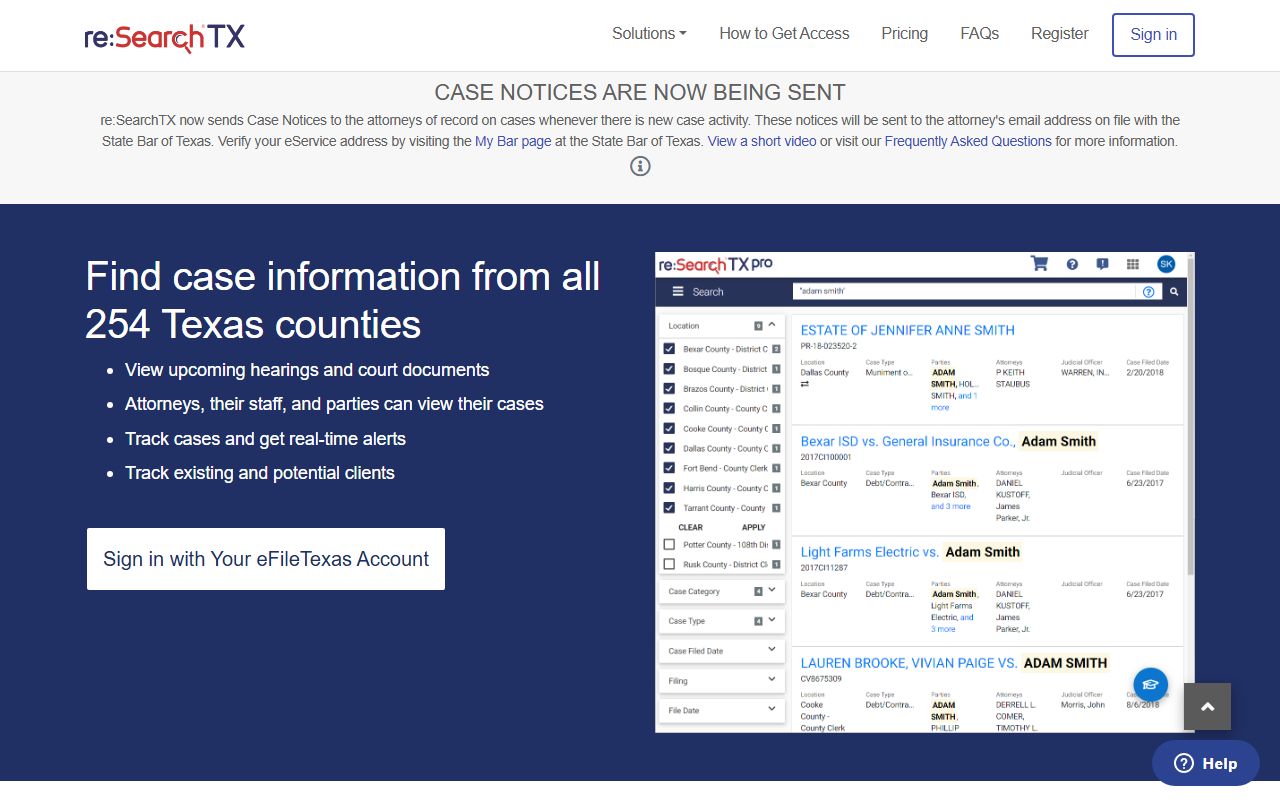
The re:SearchTX system is a free public tool for searching court records across Texas, including family cases filed in Bailey County district court.
Types of Family Court Cases in Bailey County
The Bailey County District Court handles a range of family law matters. Divorce is the most common type of case. This includes both agreed divorces and contested cases that go before a judge. The District Clerk keeps the full case file, including the final decree, any property settlement agreements, and court orders about children.
Child custody and conservatorship cases are another major category. Texas uses the term "conservatorship" rather than custody. A Standard Possession Order sets out when each parent has the children. Modifications to existing orders are also filed here. Under Texas Family Code Chapter 153, courts make conservatorship decisions based on what is in the best interest of the child.
Other family court cases in Bailey County include:
- Child support establishment and enforcement
- Paternity suits to establish legal fatherhood
- Protective orders for family violence situations
- Adoption proceedings
- Name change petitions
Child support rules fall under Texas Family Code Chapter 154. The Office of the Attorney General handles enforcement of child support orders separately from the court system. If you need to enforce a support order or report non-payment, contact the Texas OAG Child Support Division.
Filing Family Court Cases in Bailey County
To file for divorce or another family law case in Bailey County, at least one spouse must have lived in Texas for six months and in Bailey County for at least 90 days before filing. This requirement comes from Texas Family Code Section 6.301. If you do not meet the residency rule for Bailey County but do meet it for another Texas county, you file there instead.
Once you file the Original Petition, there is a mandatory 60-day waiting period before a divorce can be finalized. This comes from Texas Family Code Section 6.702. The wait period can be waived in cases involving family violence. After the petition is filed, the other party must be served with notice of the case.
Texas attorneys are required to file through eFileTexas.gov, the state's official electronic filing system. Self-represented parties are encouraged to use e-filing but are not required to. You can also file paper documents at the clerk's office in Muleshoe. All forms are accepted during regular business hours. The District Clerk's office can tell you what forms are needed for your type of case, but staff cannot give legal advice.
Note: The Texas Judicial Branch self-help page has information for people who are handling their own family law case without an attorney.
Fees and Public Access in Bailey County
Bailey County uses standard Texas fee structures for court records. Copy fees are $1.00 per page for standard paper copies. Certified copies cost more, with a certification fee added on top of the per-page rate. The clerk can tell you the current fees when you call or visit. Birth certificates are $23.00 and death certificates are $21.00 through the County Clerk. Marriage verification records are $20.00.
Family court records in Bailey County are public records under Texas Government Code Chapter 552. Any person can request copies of public court records. You do not have to be a party to the case. Some information may be protected, such as Social Security numbers, financial records submitted under seal, and anything the court has ordered closed. Juvenile records are confidential and not available to the public.
If you cannot afford court costs, you can file a Statement of Inability to Afford Payment of Court Costs. This form is available at the courthouse or through the Texas court rules and forms page. The court will review your financial situation and decide if you qualify for a fee waiver.
The Texas State Law Library provides a helpful guide to family law forms at guides.sll.texas.gov. Most forms are not fill-in-the-blank in Texas, so this guide is useful for knowing what documents you need and where to find templates.
The Texas Judicial Branch FAQ page explains how records are organized across the state and confirms that there is no single statewide database for all court records.
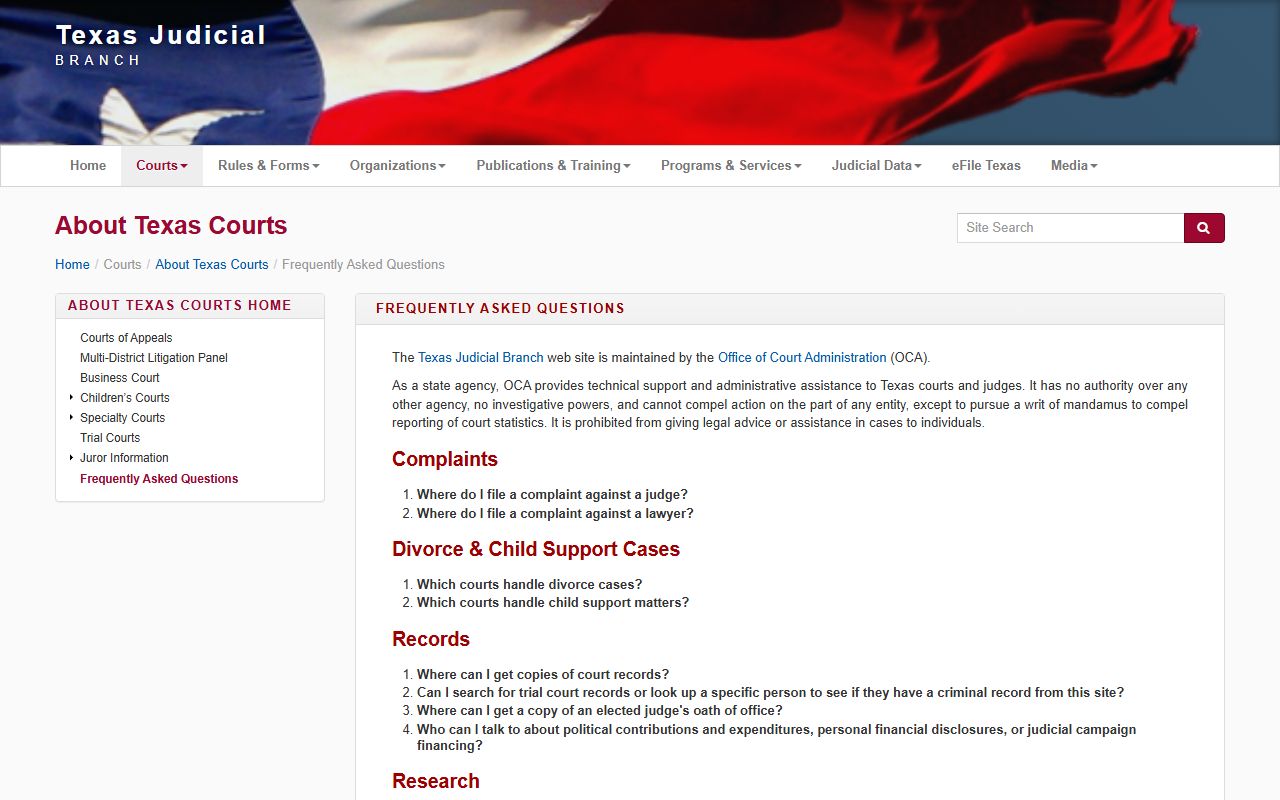
The Texas Judicial Branch FAQ page helps explain the decentralized nature of Texas court records and where to go for case information in each county.
Legal Help for Bailey County Residents
If you need help with a family court case in Bailey County, several resources are available. The Texas Judicial Branch operates a statewide self-help program for people who represent themselves in court. Visit txcourts.gov/programs-services/self-help for guides and information specific to family law cases.
TexasLawHelp is a free online resource with guides, forms, and legal information for family law matters including divorce, custody, and protective orders. Visit texaslawhelp.org to find materials that apply to your situation. The site is plain and easy to use, and it covers most common family law topics.
The Texas State Law Library provides free access to legal research tools, e-books on family law practice, and form guides. Their children and family law guide at guides.sll.texas.gov lists sources for custody forms, modification kits, and paternity documents. You can also access this library online if you live in Texas.
For vital records like divorce certificates and marriage records, the Texas Department of State Health Services Vital Statistics office maintains statewide indexes. Certified copies still come from the county clerk in the county where the event occurred.
Note: The Bailey County District Clerk staff cannot give legal advice. They can tell you what records exist and how to request them, but for guidance on how to handle your case, you need an attorney or one of the self-help resources listed above.
Cities in Bailey County
Bailey County includes the city of Muleshoe, which is the county seat. All family court cases filed by residents anywhere in Bailey County go through the district court in Muleshoe. There are no other cities in Bailey County that meet the threshold for a separate city page, but all residents use the same courthouse and the same clerk's office for family law matters.
Nearby Counties
These counties border Bailey County. If you are not certain which county handles your case, verify your home address against county lines. You must file in the county where you or your spouse lives.