
Dallam County Family Court Records
Dallam County family court records are filed and kept by the District Clerk in Dalhart, the county seat. These records cover divorce cases, child custody and support matters, paternity actions, and protective orders heard in the 69th Judicial District Court. You can search Dallam County family court records through state online tools, visit the courthouse in person during business hours, or send a written request to the clerk. Whether you need a final divorce decree, a custody order, or documents from a past case, the District Clerk is the right office to contact. Staff can search by name or case number and direct you to the right file.
Dallam County Overview
Dallam County District Clerk
The District Clerk in Dalhart is the official keeper of all family court case files in Dallam County. This office handles divorce petitions, custody and support orders, paternity cases, and any other family law matters that come before the 69th Judicial District Court. Case files go back many years and include original petitions, temporary orders, final decrees, and any post-decree changes filed after the case closed. If you are looking for a court record from a past case or need to find out the status of a current one, start with the District Clerk.
The courthouse is located at 101 E. 5th Street in Dalhart. The District Clerk and County Clerk both operate out of this building. For family court case records, you want the District Clerk. The County Clerk handles marriage licenses, property records, and probate filings. They are separate offices even though they share the same building.
| Office | Dallam County District Clerk |
|---|---|
| Address | 101 E. 5th Street, Dalhart, TX 79022 |
| Phone | (806) 244-4751 |
| Hours | Monday through Friday, 8:00 AM to 5:00 PM |
| Website | co.dallam.tx.us |
The Dallam County official website at co.dallam.tx.us lists county departments and contact information. You can use the site to find links to the clerk offices, courthouse hours, and other county services. For family court filings and record requests, the District Clerk is your primary contact.
Searching Dallam County Family Court Records
The main statewide tool for searching Texas family court records online is re:SearchTX, operated by the Texas Judicial Branch. This system covers electronic filings submitted through the state e-file system. It includes case information, party names, docket entries, and case status for many district court cases across Texas. Dallam County cases filed through the e-filing system will appear here. The system provides unofficial copies only. For certified or official copies, contact the District Clerk directly.
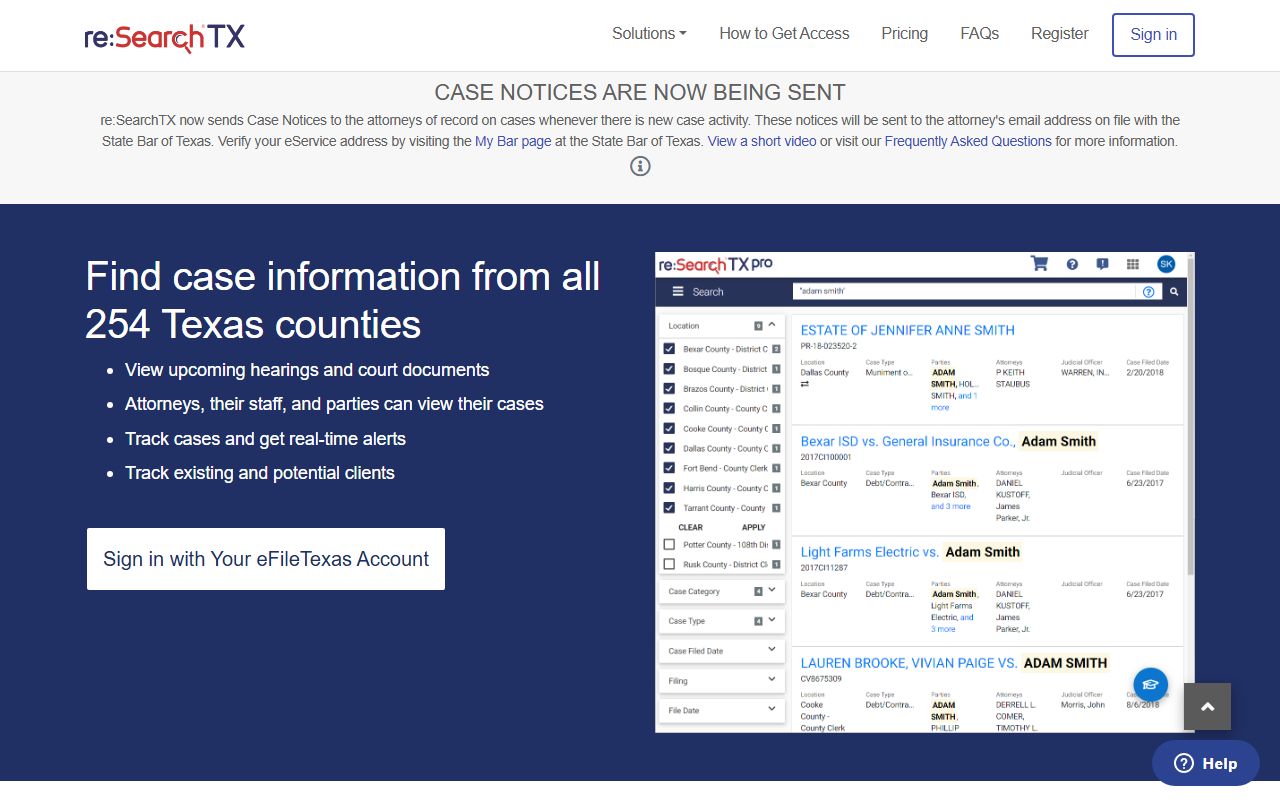
The re:SearchTX portal is the Texas Judicial Branch's statewide case search tool, covering filings submitted electronically from district courts including Dallam County.
When using re:SearchTX, search by full legal name as it appears on court documents. Try both current and former names if you are searching for someone who may have changed names. The year filed can help narrow results if you get a large list back. The system shows party names, cause numbers, and basic case information. It does not always include every document in the file, so an in-person visit or written request may be needed for complete records.
For in-person record searches, go to the courthouse at 101 E. 5th Street during business hours. Staff can look up cases by name or cause number. Public access terminals may be available at the courthouse. Bring valid ID and be ready to pay for any copies you request. Written requests can be mailed to the office. Include the case name, cause number if known, and a description of what you need.
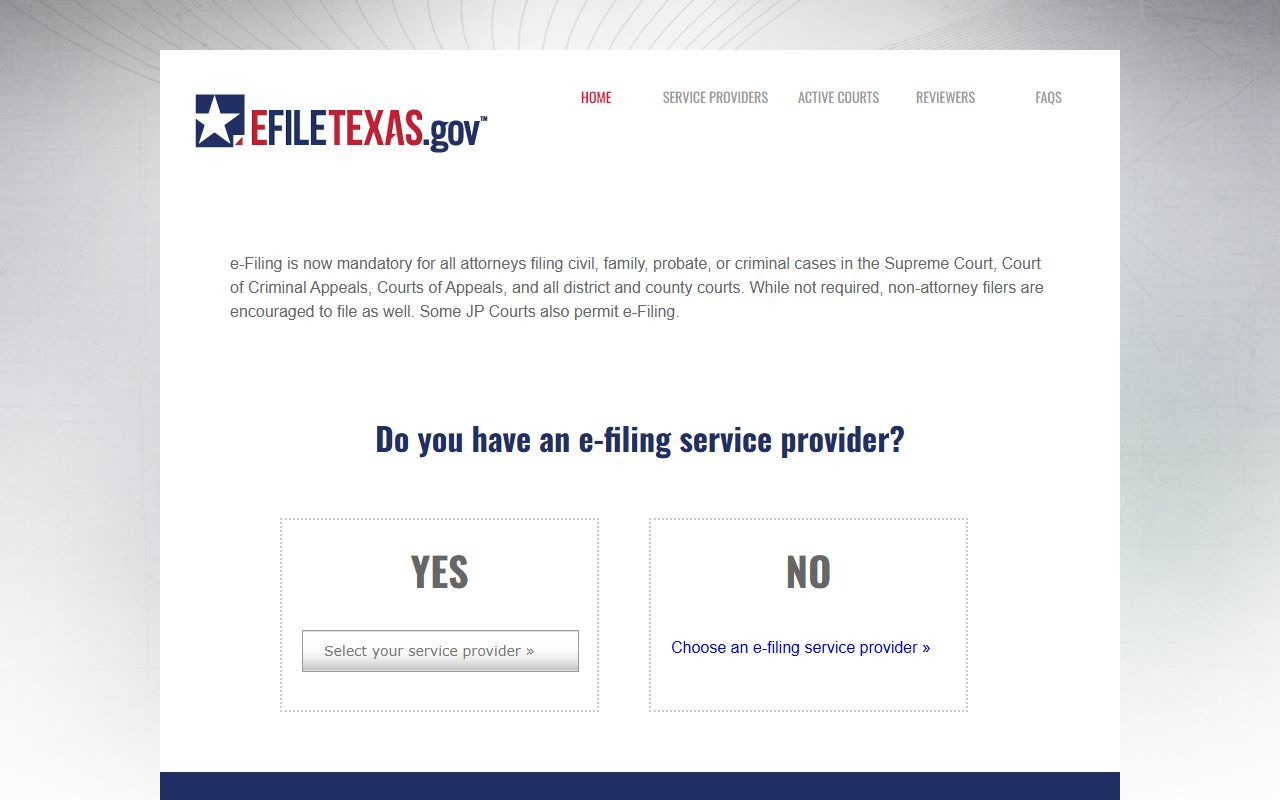
Attorneys and self-represented filers use eFileTexas.gov to submit new petitions and documents in Dallam County district court cases, including divorce and custody filings.
Types of Family Court Records in Dallam County
The 69th Judicial District Court handles all family law matters in Dallam County. Divorce cases make up a large part of the docket. Each case file contains the original petition, any temporary orders entered before the final hearing, the final decree of divorce, and documents related to property division. When children are involved, the file also includes conservatorship designations, a possession schedule, and child support orders. These documents remain part of the public court record after the case closes.
Custody and support cases that are filed apart from a divorce action are also handled by the district court. Paternity cases fall here too. The court can set or change a parent-child relationship, establish a possession schedule, and order child support payments. For enforcement of child support, the Texas Attorney General's Child Support Division handles collections separately from the court files. You can reach that office at the AG's statewide number or through texasattorneygeneral.gov.
Protective orders filed in Dallam County are also part of the district court record. Texas keeps a statewide protective order registry known as Monica's Law. This allows the public to search for orders by county, name, or date of birth. Some details are restricted to protect the person who filed. Cases involving family violence may also have sealed portions even when the basic case index is public.
Note: Adoption files, juvenile court records, and child abuse investigation records are confidential under Texas law and are not accessible through the public case index.
Filing a Family Court Case in Dallam County
To file for divorce or any family court case in Dallam County, at least one spouse must meet the residency requirement under Texas Family Code section 6.301. That means one spouse must have lived in Texas for at least six months and in Dallam County for at least 90 days before the petition is filed. If you moved to Dalhart recently, you may need to wait before you can file here.
Once the residency requirement is met, you file a petition with the District Clerk at the courthouse. Attorneys are required to use the state's e-filing system at eFileTexas.gov for civil and family cases. Self-represented filers are encouraged to use e-filing but are not required to do so. Paper filings are accepted in person at the clerk's office. The BVS 165 form must be included with divorce petitions as required by state rules.
Texas law requires a 60-day waiting period after the original petition is filed before a divorce can be granted. This rule is in Texas Family Code section 6.702. The waiting period starts on the day you file, not the day you serve the other party. You cannot skip this waiting period except in a narrow exception for cases involving documented family violence. Most uncontested divorces take longer than 60 days once service, paperwork, and court scheduling are factored in.
Texas is a community property state. Under Texas Family Code Chapter 6, the court divides marital property in a way it finds just and right. This is not always a 50-50 split. Separate property, which each spouse keeps, includes what they owned before the marriage and any gifts or inheritances they received and kept apart. The final decree sets out the full division and becomes a binding court order.
Custody and Child Support in Dallam County
Child custody matters in Texas are handled under Texas Family Code Chapter 153. Texas uses the term "conservatorship" rather than custody. The court can name one parent as the primary managing conservator or set up a joint managing conservatorship arrangement. A standard possession order lays out the schedule each parent gets with the child. Parents can also agree on a custom schedule as long as the court finds it is in the child's best interest.
Child support is set based on the income of the paying parent and the number of children covered by the order. The Texas Attorney General's office has a child support calculator and enforcement resources at texasattorneygeneral.gov. If you need to modify an existing custody or support order, you file a modification petition with the District Clerk. The court will hold a hearing and decide whether circumstances have changed enough to justify a change.
All orders related to children become part of the court file maintained by the District Clerk. These records are public in most cases. The possession schedule and support amount are standard parts of the final order. If a child's safety is at issue, the court may seal certain documents, but the basic case record stays public.
Note: Parents seeking to modify an existing custody or support order must show a material and substantial change in circumstances since the last order was entered.
Public Access and Copy Fees
Most family court records in Dallam County are public under Texas Government Code Chapter 552, also known as the Texas Public Information Act. You do not have to be a party to the case to request copies. Any member of the public can ask for plain copies of public court documents.
Standard copy fees are $1.00 per page. Certified copies carry an added certification fee on top of the per-page cost. If you submit a mail request and do not include a self-addressed stamped envelope, factor in a postage fee as well. Payment at the courthouse may be accepted in cash, check, or money order. Make checks payable to the Dallam County District Clerk. Call ahead to confirm current accepted payment methods before making a trip or sending a mail request.
Some documents in a family court file may have restricted access even when the rest of the case is public. Financial affidavits, social security numbers, records involving minor children, and sealed domestic violence documents are examples of items that may not be available to the general public. The clerk's office can tell you what is accessible in a specific case when you make your request.
Self-Help and Legal Resources
The Texas Judicial Branch maintains a self-help center at txcourts.gov for people who represent themselves in court. It has guides on how to navigate family court, what forms to expect, and what happens at each stage of a case. This is a good starting point if you are not sure where to begin.
The Texas State Law Library has a detailed guide to family law forms at guides.sll.texas.gov. Texas does not have a large library of official fill-in-the-blank forms, so the law library explains where to find templates and how to use them. The guide covers divorce, custody, paternity, protective orders, and related matters. It is free to use and updated regularly.
TexasLawHelp.org is a free resource for people who cannot afford a lawyer. The site has plain-language guides on divorce, custody, child support, and protective orders. It also has links to legal aid organizations in your region. For residents of Dallam County and the Texas Panhandle, regional legal aid providers may be able to help with low-income family law cases.
Official court forms and rules are available at txcourts.gov/rules-forms. The Texas Judicial Branch FAQ at txcourts.gov answers common questions about how to get court records and how the courts work. The Texas State Law Library also has free e-books and research guides if you need to dig deeper into a specific topic.
Cities in Dallam County
Dalhart is the county seat and the largest city in Dallam County. All family court cases filed by residents of Dallam County are heard in the district court in Dalhart.
Other communities in Dallam County include Texline, a small town near the New Mexico border. None of the cities in Dallam County meet the threshold for a dedicated city page. All family court filings from the county are handled at the courthouse in Dalhart.
Nearby Counties
Dallam County sits in the far northwestern corner of the Texas Panhandle. If you are unsure which county handles your case, confirm which county you lived in for at least 90 days before filing.