
Access Gonzales County Family Court Records
Gonzales County family court records are maintained by the District Clerk in Gonzales, Texas. These records include divorce cases, child custody orders, child support filings, paternity actions, and protective orders processed through the county's district court. You can search Gonzales County family court records using the statewide re:SearchTX portal, by contacting the District Clerk's office directly, or by visiting the courthouse in Gonzales. This page explains how to find records, what case types are kept, and what to expect when requesting copies.
Gonzales County Overview
Gonzales County District Clerk
The Gonzales County District Clerk in Gonzales manages all family court case files for the county. This includes divorce filings, custody records, support orders, and all other district court family law documents. The courthouse is at 414 St. Joseph Street in Gonzales. Staff can search cases by name or cause number and provide copies of public records.
Gonzales County is part of the 25th Judicial District, which serves multiple south-central Texas counties. The 25th District Court handles civil and family law matters. Because the district covers several counties, the judge may rotate among them. Call the clerk's office before visiting to confirm schedules and to ask about the best way to request the records you need.
| Office | Gonzales County District Clerk |
|---|---|
| Address | 414 St. Joseph St, Gonzales, TX 78629 |
| Phone | (830) 672-2801 |
| Hours | Monday through Friday, 8:00 AM to 5:00 PM |
| Website | gonzalescounty.org |
The Gonzales County Clerk is a separate office that handles marriage licenses, vital records, county court records, and property documents. The District Clerk handles family court case files. Both offices are at the courthouse in Gonzales. For a divorce decree or custody order, contact the District Clerk. For a marriage certificate, contact the County Clerk. Gonzales County is in the San Antonio Division of federal courts, though virtually all family cases remain at the state court level.
Searching Gonzales County Family Court Records
The statewide re:SearchTX portal is the primary free online search tool for Gonzales County family court records. Run by the Texas Office of Court Administration, it covers district court electronic filings since November 2018. Filter by Gonzales County and search by party name or cause number. You can see case numbers, filing dates, case types, and docket entries. For older filings not in the online system, contact the District Clerk directly.
In-person access is available at the Gonzales County Courthouse during business hours. Bring the full name of at least one party or the cause number if you have it. Staff will search the index and help you pull the file. You can review public documents at the counter and ask for copies. The fee is $1.00 per page for plain copies and $5.00 extra for certified copies.
New filings in Gonzales County go through eFileTexas. Attorneys must use the system. Self-represented parties may also file electronically or bring paper documents to the clerk's office in Gonzales during business hours.
The Texas Vital Statistics Unit at dshs.texas.gov handles certified copies of divorce certificates, which are different from the actual divorce decree held by the District Clerk. If you need only a summary document for administrative purposes, that is where to look.
Texas vital records including divorce certificates are handled through the Texas Department of State Health Services Vital Statistics Unit, separate from the District Clerk's case files.
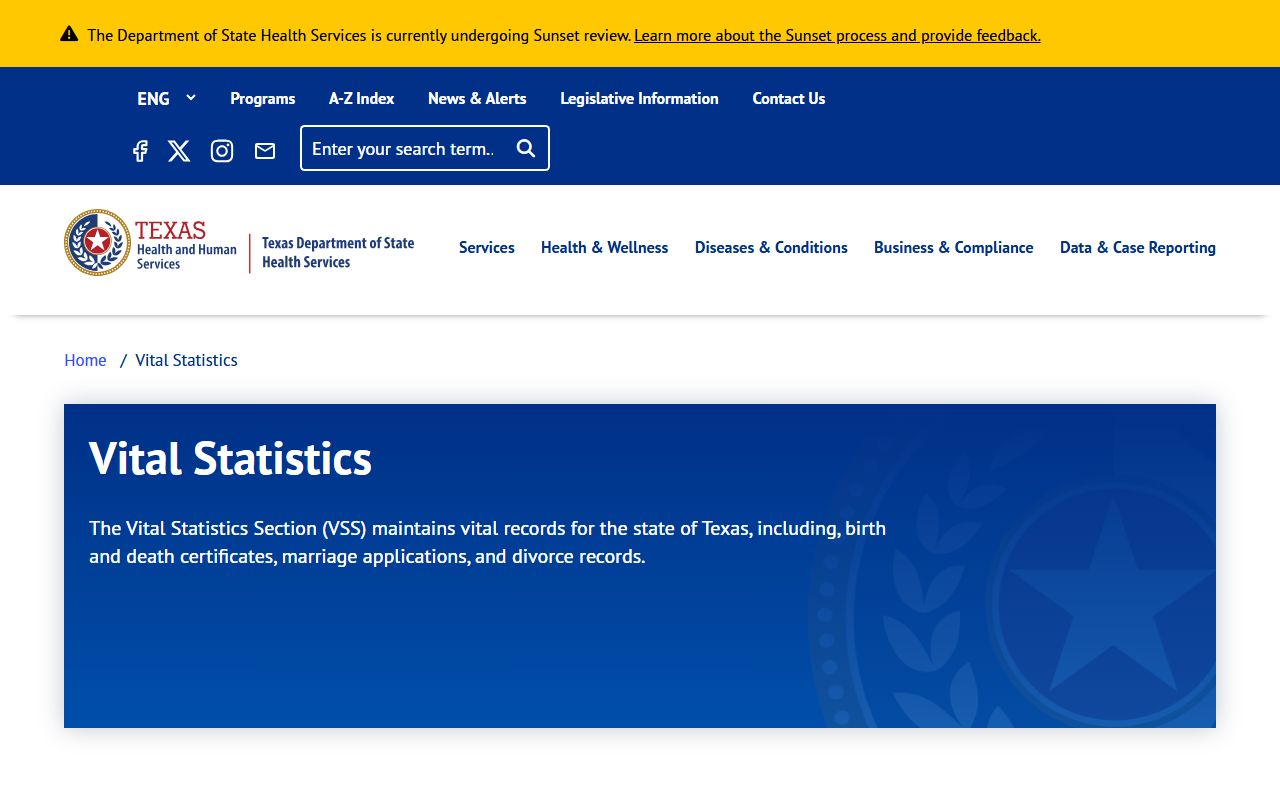
For a certified divorce certificate rather than a full decree, contact DSHS Vital Statistics. For the actual case file and decree, go to the Gonzales County District Clerk.
Family Court Record Types in Gonzales County
The District Clerk in Gonzales keeps all family court case files generated by district court proceedings. Divorce records are the most commonly searched. A divorce case file includes the original petition, service documents, any temporary or agreed orders, and the Final Decree of Divorce. The decree covers property division, conservatorship, the possession schedule, and support obligations. These are public records unless a court has sealed them.
Child custody cases and paternity actions filed outside of a divorce are suits affecting the parent-child relationship. Under Texas Family Code Chapter 153, conservatorship defines parental rights. The court focuses on the best interest of the child. These records are public. Child support orders, whether from a standalone action or as part of a divorce, are part of the public record maintained by the clerk.
Protective orders are filed through the district court and are part of the family court docket. Texas runs a statewide protective order registry under Monica's Law. Some details of these cases are restricted for safety reasons. Adoption files are sealed by Texas law. Juvenile records are confidential and not part of the public court index.
Filing for Divorce or Custody in Gonzales County
To file a divorce case in Gonzales County, you must meet the residency requirement under Texas Family Code Section 6.301. At least one spouse must have lived in Texas for six months and in Gonzales County for 90 days before filing. File the Original Petition for Divorce with the District Clerk at the courthouse in Gonzales.
After filing, Texas imposes a 60-day waiting period before the divorce can be granted. Family Code Section 6.702 sets this rule. The wait begins on the filing date. An exception applies in cases involving documented family violence. Once the waiting period ends, an agreed divorce can usually be finalized at a short hearing. Contested cases with disputed custody or property issues take significantly longer and may require a trial.
Texas is a community property state. The court divides marital assets under Texas Family Code Chapter 6 in a just and right manner. Court forms for divorce and other family law cases are available at txcourts.gov and through the Texas State Law Library. For self-help guidance, see txcourts.gov/programs-services/self-help.
Fees and Access
Gonzales County family court records are public under Texas Government Code Chapter 552. Anyone can request copies without a specific reason. Standard copy fees are $1.00 per page. Certified copies require a $5.00 certification fee in addition to the per-page charge. Payment at the courthouse in Gonzales is by cash, check, or money order.
Some records are restricted. Sealed cases, adoption files, and juvenile records are not available to the public. Financial documents within a case file may also have limited access. For fee waivers, file a Statement of Inability to Afford Payment of Court Costs under Texas Rule of Civil Procedure 145. Forms are at the clerk's office or at TexasLawHelp.org.
Legal Aid and Self-Help
Gonzales County residents can look to Texas RioGrande Legal Aid or Lone Star Legal Aid for help with family law matters. These organizations assist qualifying low-income residents with divorce, custody, and protective order cases. The Texas State Bar's referral service at (800) 252-9690 can connect you with a private family law attorney. For free self-help resources, TexasLawHelp.org has guides for every stage of a Texas family law case. The Texas AG's Child Support hotline at 800-252-8014 handles enforcement questions.
Cities in Gonzales County
Gonzales is the county seat and largest city in the county. All family court cases from Gonzales County residents are handled at the District Court in Gonzales. No cities in Gonzales County meet the threshold for a dedicated city page.
Nearby Counties
Gonzales County is in south-central Texas between San Antonio and the Gulf Coast corridor. Check your county of residence for the past 90 days to determine where to file.