
Search Tarrant County Family Court Records
Tarrant County family court records are on file at the Tarrant County District Clerk's office in Fort Worth, Texas. With a population of over 2.1 million, Tarrant County is the second most populous county in the DFW metro area and one of the busiest court systems in the state. Seven dedicated family district courts handle divorce cases, custody and conservatorship orders, child support judgments, protective orders, and related matters for residents across Fort Worth, Arlington, Mansfield, and every other community in the county. This guide covers how to search, access, and file family court records in Tarrant County.
Tarrant County Overview
Tarrant County District Clerk and County Clerk
The Tarrant County District Clerk, Tom Wilder, operates out of the Tim Curry Justice Center at 401 W. Belknap Street in Fort Worth. The main records address is 100 W. Weatherford Street, Room 130, Fort Worth, TX 76196. The District Clerk's office is reached at (817) 884-1575. This office is the official custodian of all district court records, including family law case files for the county's seven family courts: the 17th, 96th, 231st, 233rd, 322nd, 324th, and 360th Judicial District Courts.
The Tarrant County District Clerk website at tarrantcountytx.gov/en/district-clerk.html provides online access to case information and the court document lookup service. You can search by party name, case number, or attorney name. The system also allows filtering by case type including family, so you can narrow results to divorce and custody cases specifically. Tarrant County's online system shows both active and closed cases.
The official Tarrant County District Clerk website provides comprehensive case search and document access tools for family court records in Fort Worth and throughout the county.

The Tarrant County District Clerk at tarrantcountytx.gov/en/district-clerk.html provides online case search, document lookup, and information about all district court proceedings including family court cases in Fort Worth and Tarrant County.
The Tarrant County Clerk, Mary Louise Garcia, is located at 100 W. Weatherford Street, Room 130, Fort Worth, TX 76196, phone (817) 884-1195. The County Clerk handles marriage licenses, vital records, real property records, assumed names, and probate records for the County Courts at Law. If you need marriage licenses or vital statistics rather than family court case files, the County Clerk is the right office to contact.
| District Clerk | Tom Wilder |
|---|---|
| District Clerk Address | 100 W. Weatherford St., Room 130, Fort Worth, TX 76196 |
| District Clerk Records Address | 2701 Kimbo Rd., Fort Worth, TX 76111 |
| District Clerk Phone | (817) 884-1575 |
| County Clerk | Mary Louise Garcia |
| County Clerk Address | 100 W. Weatherford St., Room 130, Fort Worth, TX 76196 |
| County Clerk Phone | (817) 884-1195 |
| Hours | Monday through Friday, 8:00 AM to 5:00 PM |
How to Search Tarrant County Family Court Records
Tarrant County has a dedicated Court Document Lookup service at tarrantcountytx.gov/en/district-clerk/services/district-clerk-court-document-lookup.html. This service provides online access to case documents including petitions, orders, and final decrees. Free self-service document lookup is available at public access computers at the Tim Curry Justice Center. For remote access, a subscription service is available at $120 initiation fee plus $35 per month. Subscribers get access to District Court Civil, Delinquent Tax, Family, Felony, and Misdemeanor records 23 hours a day, 7 days a week.
The Tarrant County Court Document Lookup service provides detailed access to family court case filings including petitions, orders, and final decrees for divorce and custody cases in Fort Worth.
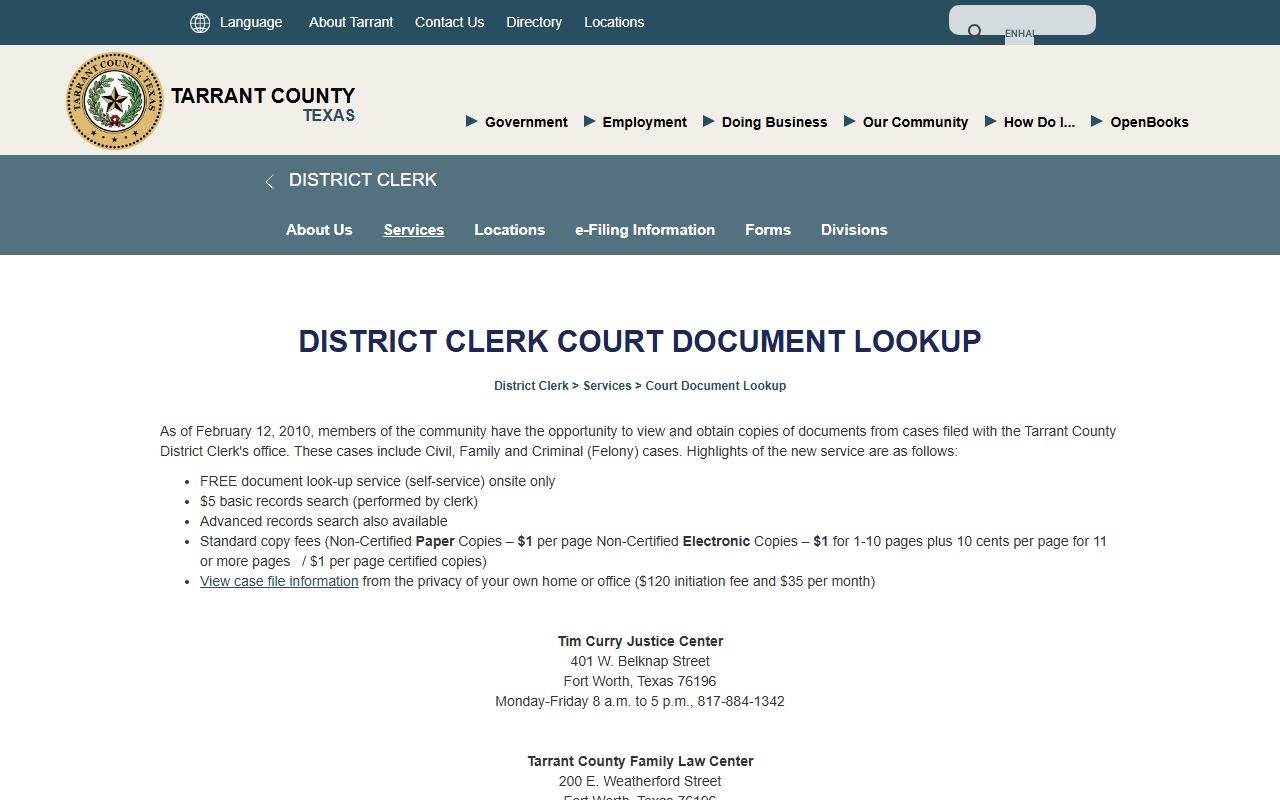
The Tarrant County District Clerk court document lookup service at tarrantcountytx.gov allows public access to case filings, final decrees, and other family court documents for divorce, custody, and support cases in Fort Worth and throughout Tarrant County.
To use the online search, you can search by party name (Last, First, Middle), case number, attorney name, or date range. Use the "%" symbol as a wildcard when doing partial name searches. You can filter results by case type (Family, Civil, Criminal, Probate), court number, and whether cases are active or closed. Click any case number in the results to see detailed docket information. Viewable documents include petitions, orders, and final decrees. Restricted documents such as those containing Social Security numbers or home addresses of protected parties are not available for public view.
The statewide re:SearchTX system at research.txcourts.gov is another tool that covers Tarrant County cases filed through the state e-filing platform. This is useful as a secondary search tool or for finding cases across multiple Texas counties in one search. Staff-conducted basic records searches cost $5.00 per name. Non-certified paper copies are $1.00 per page, and electronic copies are $1.00 for 1-10 pages then $0.10 per additional page. Certified copies are $1.00 per page with a $5.00 certification fee per document. Advanced research requests may incur additional fees at $15.00 per hour.
Tarrant County Family Court Case Types
Tarrant County's seven family district courts handle the full range of family law matters for one of Texas's largest counties. Divorce cases are filed under Texas Family Code Chapter 6. Texas allows no-fault divorce on grounds of insupportability, meaning either spouse can file without proving fault. The court divides community property in a just and right manner. Fault-based grounds including cruelty, adultery, abandonment, and felony conviction are also available. Tarrant County handles both agreed divorces and fully contested cases that go to trial.
Custody and conservatorship cases follow the framework in Texas Family Code Chapter 153. Courts use the best interest of the child as the governing standard for all custody decisions. Joint managing conservatorship is presumed appropriate in most cases. The Standard Possession Order is the default schedule and sets out specific times for each parent, including first, third, and fifth weekends, spring break, extended summer time, and holidays. Courts can enter a modified schedule when specific facts support a different arrangement. Cases involving military parents stationed at or near NAS Fort Worth Joint Reserve Base may involve specific deployment and relocation considerations.
Child support cases in Tarrant County follow the guidelines in Chapter 154. The percentage is applied to the paying parent's net monthly resources. Medical support and health insurance coverage requirements are typically included in every child support order. Other cases handled in Tarrant County's family courts include paternity suits, step-parent adoptions, protective orders, name changes, and post-decree modifications and enforcement proceedings.
Filing Family Cases in Tarrant County
To file a divorce or family law case in Tarrant County, at least one spouse must meet the residency requirement in Texas Family Code Section 6.301. That means living in Texas for six months and in Tarrant County for 90 days before filing. You file the Original Petition for Divorce or other family law petition at the Tarrant County District Clerk's office. Attorneys must use eFileTexas.gov for mandatory electronic filing of all new case initiations and subsequent documents. Self-represented litigants may still file paper documents at the clerk's office or choose to use e-filing.
After filing, the 60-day waiting period under Texas Family Code Section 6.702 applies. No final divorce can be granted until at least 60 days pass from the filing date. The exception is when family violence is alleged. During the waiting period, parties may seek temporary orders for custody, child support, spousal support, and use of the marital home. After the waiting period, agreed divorces can be finalized at a prove-up hearing. Contested cases proceed through discovery, mediation, and potentially trial in front of the judge.
Tarrant County filing fees for divorce cases typically range from $300 to $450 depending on whether children are involved and what additional fees apply. Protective order filings have no fee under Texas law. If you cannot afford court costs, you may file a Statement of Inability to Afford Payment of Court Costs at the clerk's office or download it from the Texas courts website. Forms for most family law case types are available through the Texas courts website and the Texas State Law Library.
Public Access and Fees in Tarrant County
Tarrant County family court records are public records under Texas Government Code Chapter 552. The Texas Public Information Act gives any person the right to request copies of public case files. Non-certified paper copies cost $1.00 per page. Electronic copies are $1.00 for 1-10 pages and $0.10 per page after that. Certified copies cost $1.00 per page with an additional $5.00 certification fee per document. Exemplified copies are $10.00 per document. Staff-conducted research searches are $5.00 per name, with complex research at $15.00 per hour.
The County Clerk website at tarrantcountytx.gov/en/county-clerk.html provides access to marriage licenses, vital records, and real property records maintained by the County Clerk's office.

The Tarrant County Clerk at tarrantcountytx.gov/en/county-clerk.html handles marriage licenses, vital records, probate records, and assumed name filings for Fort Worth and all of Tarrant County, complementing the District Clerk's family court records.
Certain records in Tarrant County family cases are restricted from public access. Adoption files are confidential and sealed. Juvenile records are not publicly accessible. Social Security numbers, financial account numbers, and the home addresses of parties who have active protective orders are redacted from documents before public release. Courts can also seal specific records by court order. If you believe a public record was improperly withheld, you can appeal to the Texas Attorney General's Open Government Hotline at (877) 673-6839 under the Texas Public Information Act at Government Code Chapter 552.
The public access subscriber service provides additional access to District Court records with imaged documents. Subscription levels differ by the number of users. All subscribers must complete a subscriber agreement and pay the processing fee before access is granted. The service is designed for attorneys, title companies, employers, investigators, landlords, and journalists who need regular access to court records.
Note: Tarrant County's public access terminals at the Tim Curry Justice Center are free for in-person use and allow full document viewing without subscription fees or per-page charges at the terminal.
Legal Help in Tarrant County
The Texas Judicial Branch self-help program at txcourts.gov/programs-services/self-help offers free guides for people handling their own family law cases in Texas courts. The site explains the process for divorce, custody, support, and protective orders in plain terms. It includes resources on what forms to use, how hearings work, and what to expect at each stage of a case.
TexasLawHelp at texaslawhelp.org provides free family law guides and downloadable forms for Texas residents. The site covers divorce, custody, child support, protective orders, and modifications. Many guides come with step-by-step instructions and are available in both English and Spanish. The site also has a legal aid directory that can point you to free help in the Fort Worth area based on your income.
Tarrant County has several legal aid options for qualifying residents. Legal Aid of Northwest Texas serves Tarrant County and provides free civil legal services for low-income residents, including family law matters. The Tarrant County Bar Association also has a lawyer referral service that can connect you with a licensed family law attorney in the Fort Worth area. The State Bar of Texas lawyer referral line is (800) 252-9690. The Texas State Law Library family law guide at guides.sll.texas.gov provides detailed instructions for filling out forms in custody, modification, and paternity cases.
Cities in Tarrant County
Tarrant County includes Fort Worth, Arlington, Mansfield, and many other communities. All family court cases for residents anywhere in Tarrant County are filed at the Tarrant County courthouse system in Fort Worth, regardless of which city you live in.
Other communities in Tarrant County include Hurst, Euless, Bedford, Keller, Southlake, Grapevine, Colleyville, Richland Hills, Watauga, Haltom City, and North Richland Hills. All residents file their family court cases at the Tarrant County courthouse system in Fort Worth.
Nearby Counties
These counties border Tarrant County. Verify your address to confirm which county's court system handles your family law case.